
Wednesday, 29 July 2026


Pharmacists cannot open clinics to diagnose disease & prescribe medicine; clarifies PCI
Clearing the doubts on pharmacists can open pharma clinics to treat common disease and prescribe medicine, Pharmacy Council of India (PCI) has recently notified that the pharmacists cannot open clinics to diagnose the disease and prescribe the medicines.
PCI has clarified that there is no provision in the Pharmacy Practice Regulations (PPR), 2015 which allows the pharmacists to practice medicine. Under the said Regulations, the registered pharmacist is required to dispense medicines on the prescription of a registered medical practitioner and can counsel the patient or care giver on medicine to enhance or optimise drug therapy.
The elements of patient counselling includes, name and description of the drugs;the dosage form, dose, route of administration, and duration of drug therapy; intended use of the drug and expected action; special directions and precautions for the drug; common severe side effects or adverse effects or interactions and therapeutic contraindications that may be encountered, including their avoidance, and the action required if they occur; techniques for self monitoring drug therapy; proper storage of the drugs; prescription refill information; action to be taken in the event of a missed dose and to ensure rational use of drugs.
Dr. B Suresh, president of PCI informed that there are few groups of pharmacists who are claiming that they are doctors and there are various messages being circulated on social media, e-mails, WhatsApp etc. that pharmacists are empowered under PPR, 2015 to open pharma clinics to diagnose the disease and prescribe medicines.
We would like to clarify that there are no such provision under PPR, 2015 which allows pharmacists to diagnose and prescribe medicine. PPR, 2015 only allows the pharmacists to practice pharmacy and not medicine, they can counsel the patient or care giver and dispense medicines on the prescription of a registered medical practitioner but cannot prescribe medicines to the patients
He further adds, “Under no circumstances, the registered pharmacist is empowered under the Pharmacy Act, 1948 and PPR, 2015 to practice medicines or open clinics to provide medical care.

PCI has clarified that there is no provision in the Pharmacy Practice Regulations (PPR), 2015 which allows the pharmacists to practice medicine. Under the said Regulations, the registered pharmacist is required to dispense medicines on the prescription of a registered medical practitioner and can counsel the patient or care giver on medicine to enhance or optimise drug therapy.
The elements of patient counselling includes, name and description of the drugs;the dosage form, dose, route of administration, and duration of drug therapy; intended use of the drug and expected action; special directions and precautions for the drug; common severe side effects or adverse effects or interactions and therapeutic contraindications that may be encountered, including their avoidance, and the action required if they occur; techniques for self monitoring drug therapy; proper storage of the drugs; prescription refill information; action to be taken in the event of a missed dose and to ensure rational use of drugs.
Dr. B Suresh, president of PCI informed that there are few groups of pharmacists who are claiming that they are doctors and there are various messages being circulated on social media, e-mails, WhatsApp etc. that pharmacists are empowered under PPR, 2015 to open pharma clinics to diagnose the disease and prescribe medicines.
We would like to clarify that there are no such provision under PPR, 2015 which allows pharmacists to diagnose and prescribe medicine. PPR, 2015 only allows the pharmacists to practice pharmacy and not medicine, they can counsel the patient or care giver and dispense medicines on the prescription of a registered medical practitioner but cannot prescribe medicines to the patients
He further adds, “Under no circumstances, the registered pharmacist is empowered under the Pharmacy Act, 1948 and PPR, 2015 to practice medicines or open clinics to provide medical care.
BUT, My query is : Can a registered pharmacist(PHARM D) approved with Clinical Pharmacy Council give PHARMA CARE in his PHARMACY? Services like prior authorization and refill authorization for prescription drugs is permitted?
A new development may occur:
Tuesday, 28 July 2026
Always double-check your medication classifications—especially when names sound similar—to avoid taking the wrong treatment.
🖤 कुछ जानकारी दे रहा हूँ, आप जो दवाएँ खाते है या डॉक्टर लिखता है वह किसलिये दे रहा है.....
क्योंकि आजकल अगर जरूरत 1 दवा की है, डॉक्टर 4 साथ में देगा क्योंकि कम्पनी विदेश का टूर जो देती है ....
😊....आज इतना सीख लें...
❤️......प्रत्येक अंग्रेजी दवा के अंत मे एक शब्द होता है जिससे जान सकते है वह दवा किस काम आएगी.....😊
CAIN.........❤️❤️
Xylocaine
Benzocaine
Amylocaine
Lidocaine
ये एक लोकल इनेस्थेटिक है, अर्थात ये दवाईया किसी अंग को सुन्न करने के लिए दी जाती है
MYCIN........❤️❤️
Azithromycin
Erythromycin
Neomycin
Strptomycin
ये एंटीबायोटिक है अर्थात इंफेक्शन के लिए दी जाती है
OLOL.........❤️❤️
Metaprolol
Atenolol
Esmolol
Bisoprolol
ये बीटा ब्लॉकर्स होते है अर्थात इनका प्रयोग हाइपरटेंशन, या हार्ट अटैक /HIGH BP में करते है
MIDE & ZIDE.........❤️❤️
Furosemide
Bumetanide
Benzthiazide
Chlorothiazide
ये डाइयुरेटिक्स है अर्थात यूरीन को बढ़ाती है, शरीर मे सूजन होती है या BP ज्यादा होता है उन्हें देते है
VIR........❤️❤️
Acyclovir
Ritonavir
Indinavir
ये एन्टीवायरल है अर्थात वायरस के इंफेक्शन में प्रयोग करते है
PAM........❤️❤️
Diazepam
Lorazepam
ये एंटीएंजाइटी है अर्थात घबराहट बेचैनी नींद न आने में दी जाती है
STATIN......❤️❤️
Atorvastatin
Simvastatin
Lovastatin
इसका प्रयोग एंटी हायपर लिपिडेमिक्स में होता है अर्थात जिनका कोलस्ट्रॉल बढ़ जाता है उन्हें देते है
SONE........❤️❤️
Betamethasone
Cortisone
Dexamethasone
ये स्टेरॉइड है अर्थात सूजन को दूर करने के लिए
AZOLE.........❤️❤️
Ketoconazole
Fluconazole
Econazole
Miconazole
एंटीफंगल है अर्थात फंगल इंफकेशन में दी जाती है
TIDINE.........❤️❤️
Ranitidine
Cimetidine
Famotidine
Roxatidine
ये H2 रिसेप्टर ब्लोकर है अर्थात पेट मे एसिड को कम करती है, पेप्टिक अल्सर में प्रयोग होता है
SETRON.........❤️❤️
Ondasetron
Grenisetron
Dolosetron
5HT3 एनटागोनिस्ट होती है अर्थात उल्टी, चक्कर मे दी जाती है
OFLOXACIN.......❤️❤️
Ciprofloxacin
Norfloxacin
Levofloxcin
ये एंटीबैक्टीरियल हैं
NIDAZOLE.........❤️❤️
Metronidazole
Ornidazole
Tinidazole
ये एन्टीअमेबिक हैं अर्थात दर्द के साथ दस्त में दी जाती है।
TRIPTAN..........❤️❤️
Sumatriptan
Rizatriptan
Naratripton
5HT एगोनिस्ट होती है अर्थात माइग्रेन में दी जाती है।
PROFEN.........❤️❤️
Ibuprofen
Ketoprofen
Flurbiprofen
ये नॉन स्ट्रोइडल एंटी इन्फ्लामेट्री ड्रग्स होती है अर्थात सूजन, बुखार, दर्द आदि में दिया जाता है।
PRAZOLE........❤️❤️
Pantoprazole
Omeprazole
Esomeprazole
Rabeprazole
ये प्रोटोन पम्प इन्हेबिटर है अर्थात पेट मे एसिड कम करती है और पेट मे हाइड्रोजन पोटेशियम पम्प को बन्द कर देती ह, गेस्ट्रो सम्बन्धी पेप्टिक अल्सर में प्रयोग करते हैं।
GLIPTIN........❤️❤️
Sitagliptin
Vildagliptin
Alogiptin
Linagliptin
DDP 4 इन्हेबिटर हैं, अर्थात डाइबिटीज में प्रयोग होता है !
😊 🙏
However,
Not always true.....
Aripiprazole (often sold under the brand name Abilify) is an atypical antipsychotic medication primarily used to treat schizophrenia, bipolar disorder, and major depressive disorder.It is frequently confused with Proton Pump Inhibitors (PPIs) because it shares the same "-prazole" suffix, but the two are completely different:Aripiprazole: An antipsychotic that stabilizes dopamine and serotonin systems in the brain.PPIs (e.g., Omeprazole, Pantoprazole): Acid-reducing medications used to treat gastroesophageal reflux disease (GERD) and peptic ulcers.
Always double-check your medication classifications—especially when names sound similar—to avoid taking the wrong treatment. You can verify medication profiles and interactions using the Drugs.com Drug Interactions Checker or the Mayo Clinic Drugs and Supplements database.
A new development may occur

The article says Pharmacist may open his own Clinic and can do practice (First Aid), but before that 3 months of clinical practice with a M.B.B.S physician is essential.
Monday, 27 July 2026
Medical Science vs Pharmaceutical Science (Residential Program Year)
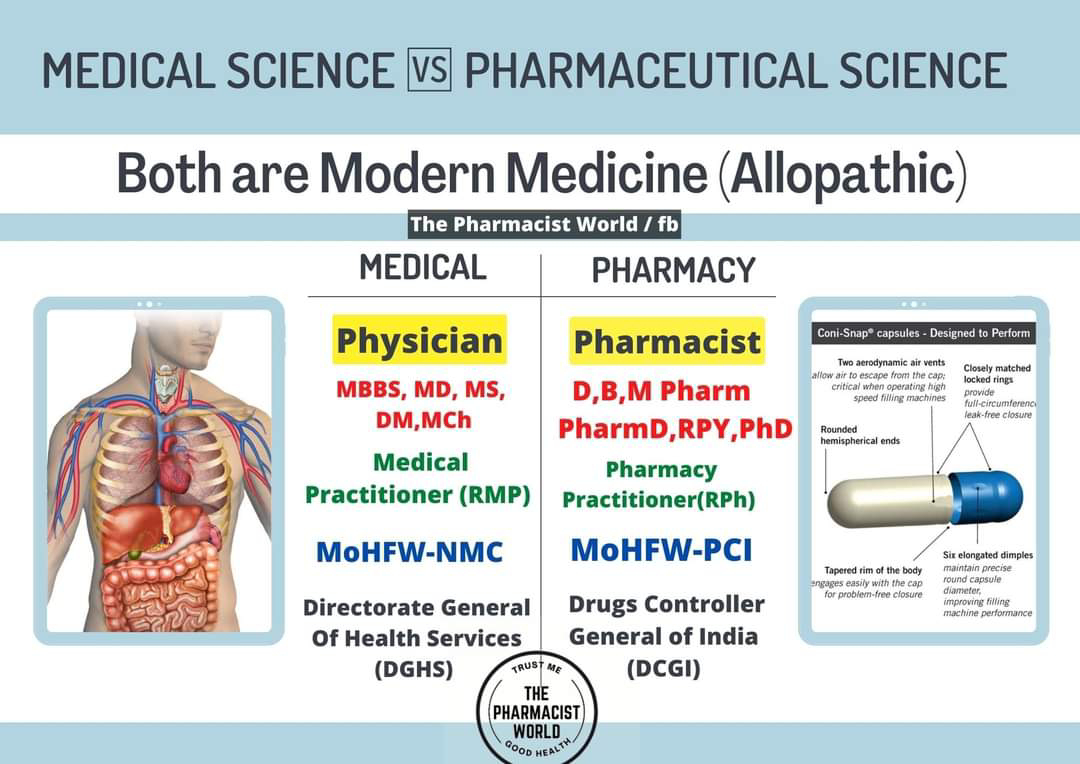
However, Pharmacy is not limited to Allopathic medicines. It also imbibes AYUSH medicines.
**Yes, modern pharmacy actively incorporates and collaborates with AYUSH systems** (Ayurveda, Yoga & Naturopathy, Unani, Siddha, and Homoeopathy) in several key ways:
### 1. Retail & Commercial Availability
* **Over-the-Counter & Integrated Pharmacies:** Modern retail pharmacies routinely stock and sell AYUSH medicines alongside conventional allopathic drugs.
* **Regulatory Distinction:** Under the *Drugs and Cosmetics Act*, classical AYUSH formulations generally do not require a separate retail drug license compared to allopathic pharmaceuticals, making them easily accessible in retail drugstores across India.
### 2. Integrative Healthcare & Government Policy
* **Co-Location Strategy:** Under the National Health Mission (NHM), the Government of India has systematically co-located AYUSH facilities within Primary Health Centres (PHCs), Community Health Centres (CHCs), and District Hospitals. These setups often share unified hospital pharmacies or dual-dispensing counters to offer integrative choices under a single roof.
* **Central Oversight:** An exclusive **AYUSH vertical** exists within the Central Drugs Standard Control Organization (CDSCO) to standardize, monitor quality, and regulate AYUSH manufacturing and pharmacy standards.
### 3. Pharmaceutical Research & Education
* **Pharmacognosy & Phytotherapy:** B.Pharm and M.Pharm curricula cover *Pharmacognosy*—the study of medicinal drugs derived from plants and natural sources—which heavily overlaps with the herbal formulations of Ayurveda, Siddha, and Unani.
* **Standardization & Quality Control:** Modern pharmaceutical technologies (like high-performance liquid chromatography, standardized extraction, and micro-encapsulation) are widely used to manufacture, validate, and standardize classical AYUSH medicines for batch-to-batch consistency and global export.
RPY: Residential Program Year
Pharmacy residency is education a pharmacist can pursue beyond the degree required for licensing as a pharmacist (in the United States of America: PharmD). A pharmacy residency program allows for the implementation of skill set and knowledge acquired in pharmacy school through interaction with the public either in a hospital setting or community practice.The program is done over a span of about two years after graduation from pharmacy school and licensure as a pharmacist. Pharmacy residency helps improve the resume of a pharmacist so as to increase chances of obtaining employment outside community practice. A 2022 review suggested that there is sufficient evidence that residency develops key competencies for junior pharmacists
In India, after completing a Pharm.D. (Doctor of Pharmacy) degree, students can pursue residency programs to specialize in clinical pharmacy or related fields, enhancing their expertise and career prospects. These programs, often lasting one to two years, provide advanced training in areas like clinical pharmacy practice, patient care, and drug information.
Details about Pharm.D. and Residency in India:
- Pharm.D. as a Professional Qualification:The Pharm.D. is a professional doctorate recognized by the Pharmacy Council of India (PCI). It signifies expertise in pharmacy practice and allows graduates to become licensed pharmacists.
- Residency Programs:
- Following the Pharm.D., residency programs offer specialized training in various clinical settings, such as hospitals and clinics.
- Focus Areas:
- Residency programs can focus on areas like:
- Clinical Pharmacy: Providing patient-centered care, medication therapy management, and drug information services.
- Critical Care: Managing patients in intensive care units, focusing on advanced life support and critical care protocols.
- Other Specializations: Opportunities may also exist in areas like oncology, cardiology, and infectious disease, depending on the specific program and institution.
- Career Paths:
- Residency training can lead to various career opportunities, including:
- Clinical Pharmacist Roles: In hospitals and other healthcare settings, directly involved in patient care.
- Medical Affairs: Bridging the gap between pharmaceutical companies and healthcare professionals, providing scientific expertise and support.
- Research: Participating in clinical trials and research activities.
- Duration:Residency programs typically last one to two years, depending on the specialization and institution.
- Benefits:Residency programs offer valuable practical experience, enhance clinical skills, and improve career prospects for Pharm.D. graduates.
Residency Medicine
Residency or postgraduate training is a stage of graduate medical education. It refers to a qualified physician (one who holds the degree of MD, DO, MBBS/MBChB), veterinarian (DVM/VMD, BVSc/BVMS), dentist (DDS or DMD), podiatrist (DPM), optometrist (OD), pharmacist (PharmD), or Medical Laboratory Scientist (Doctor of Medical Laboratory Science) who practices medicine or surgery, veterinary medicine, dentistry, optometry, podiatry, clinical pharmacy, or Clinical Laboratory Science, respectively, usually in a hospital or clinic, under the direct or indirect supervision of a senior medical clinician registered in that specialty such as an attending physician or consultant.
The term residency is named as such due to resident physicians (resident doctors) of the 19th century residing at the dormitories of the hospital in which they received training.[1]
In many jurisdictions, successful completion of such training is a requirement in order to obtain an unrestricted license to practice medicine, and in particular a license to practice a chosen specialty. In the meantime, they practice "on" the license of their supervising physician. An individual engaged in such training may be referred to as a resident physician, house officer, registrar or trainee depending on the jurisdiction. Residency training may be followed by fellowship or sub-specialty training.[2]
Whereas medical school teaches physicians a broad range of medical knowledge, basic clinical skills, and supervised experience practicing medicine in a variety of fields, medical residency gives in-depth training within a specific branch of medicine.
In India, medical residency, also known as postgraduate training, typically lasts for 3 years after completing the MBBS degree. It's a period of intensive clinical training in a chosen specialty, preparing doctors for independent practice. The residency program is structured with academic coursework, clinical rotations in various departments, and research components, culminating in an MD or MS degree (depending on the specialty).
Key aspects of medical residency in India:
- Duration: Generally 3 years for most specialties, but can vary.
- Eligibility: Requires completion of MBBS and passing the NEET-PG exam.
- Structure: Includes clinical rotations, academic learning (case discussions, seminars, etc.), and research.
- Focus: Hands-on clinical experience and development of practical skills under supervision.
- Outcome: Leads to an MD or MS degree in the chosen specialty and prepares doctors for independent practice.
- Supervision: Residents work under the guidance of attending physicians and consultants.
- Workload: Residents typically work long hours, including nights, weekends, and holidays.
Pharmacy is not limited to Allopathic medicines. It also imbibes AYUSH medicines
However, Pharmacy is not limited to Allopathic medicines. It also imbibes AYUSH medicines.
**Yes, modern pharmacy actively incorporates and collaborates with AYUSH systems** (Ayurveda, Yoga & Naturopathy, Unani, Siddha, and Homoeopathy) in several key ways:
### 1. Retail & Commercial Availability
* **Over-the-Counter & Integrated Pharmacies:** Modern retail pharmacies routinely stock and sell AYUSH medicines alongside conventional allopathic drugs.
* **Regulatory Distinction:** Under the *Drugs and Cosmetics Act*, classical AYUSH formulations generally do not require a separate retail drug license compared to allopathic pharmaceuticals, making them easily accessible in retail drugstores across India.
### 2. Integrative Healthcare & Government Policy
* **Co-Location Strategy:** Under the National Health Mission (NHM), the Government of India has systematically co-located AYUSH facilities within Primary Health Centres (PHCs), Community Health Centres (CHCs), and District Hospitals. These setups often share unified hospital pharmacies or dual-dispensing counters to offer integrative choices under a single roof.
* **Central Oversight:** An exclusive **AYUSH vertical** exists within the Central Drugs Standard Control Organization (CDSCO) to standardize, monitor quality, and regulate AYUSH manufacturing and pharmacy standards.
### 3. Pharmaceutical Research & Education
* **Pharmacognosy & Phytotherapy:** B.Pharm and M.Pharm curricula cover *Pharmacognosy*—the study of medicinal drugs derived from plants and natural sources—which heavily overlaps with the herbal formulations of Ayurveda, Siddha, and Unani.
* **Standardization & Quality Control:** Modern pharmaceutical technologies (like high-performance liquid chromatography, standardized extraction, and micro-encapsulation) are widely used to manufacture, validate, and standardize classical AYUSH medicines for batch-to-batch consistency and global export.
Friday, 24 July 2026
Can a pharmacist sell Homeopathic medicines, Unani medicines, Siddha medicines and Ayurvedic medicines?
**Yes, a pharmacist can sell homeopathic medicines**, but the specific rules depend on the regulations of the country or state.
In general, licensed pharmacists are legally permitted to dispense homeopathic products alongside conventional (allopathic) medicines, provided they meet local regulatory requirements.
### How Regulations Work by Region
| Country / Region | Regulatory Framework & Requirements |
|---|---|
| **India** | Under the **Drugs & Cosmetics Act**, standard registered pharmacies can sell over-the-counter (OTC) homeopathic medicines directly. However, to run a dedicated homeopathic pharmacy or deal in specialized/prescription-grade homeopathic drugs, a specific **Homeopathic Drug License (Form 20-C)** is required. |
| **United States** | Homeopathic products are regulated as drugs by the **FDA**. Pharmacists can sell over-the-counter homeopathic remedies. They do not require a separate license beyond their standard pharmacy license. |
| **United Kingdom & EU** | Homeopathic products are registered under special simplified procedures (often under the **MHRA** in the UK). Pharmacists can stock and retail them if the product is registered and labeled in compliance with health authority standards. |
### Key Requirements for Pharmacists
1. **Product Compliance:** The homeopathic medicine must be legally registered with the national drug controller (e.g., Central Drugs Standard Control Organization in India, FDA in the US, or MHRA in the UK).
2. **OTC vs. Prescription:** Over-the-counter homeopathic remedies (like simple Arnica gels or cold tinctures) can usually be sold without a prescription. Controlled or high-potency formulations may require a qualified practitioner’s prescription depending on jurisdiction.
3. **Separate Storage (In some regions):** Certain drug control guidelines require pharmacies carrying both conventional and alternative medicines to store homeopathic products in separate designated shelving to prevent cross-contamination or labeling confusion.
**Yes, a registered pharmacist or retail chemist can stock and sell Unani medicines**, but there are key regulatory details regarding *how* and *which* Unani medicines can be sold under Indian law (the *Drugs and Cosmetics Act, 1940*).
## 1. Over-the-Counter (OTC) Unani Medicines
* **No Separate License Needed:** Under Chapter IV-A of the *Drugs and Cosmetics Act*, most general over-the-counter Unani, Ayurvedic, and Siddha medicines do not require a separate specialized AYUSH retail license to be stocked in a standard medical store.
* **Any Registered Pharmacist Can Sell:** A pharmacist holding a valid Retail Drug License for an allopathic pharmacy can legally stock and sell standard OTC Unani health products and syrups.
## 2. Prescription-Only Unani Medicines (Schedule E1)
* Certain Unani formulations contain heavy metals, mineral compounds, or potent botanical ingredients listed under **Schedule E(1)** of the *Drugs and Cosmetics Rules*.
* These specific medicines **cannot be sold freely over the counter**. They must only be dispensed against a valid prescription issued by a qualified, registered Unani practitioner (Hakim / BUMS degree holder).
## 3. Selling vs. Compounding / Manufacturing
| Activity | Requirement |
|---|---|
| **Retail Sale (OTC Unani)** | Standard chemist shop / pharmacy setup. |
| **Dispensing Schedule E(1) Drugs** | Valid prescription from a registered Unani doctor. |
| **Compounding / Manufacturing Unani Medicines** | Requires an **AYUSH Manufacturing License** and a qualified Unani technical expert (BUMS degree or Unani Pharmacy diploma holder). |
> **Key Takeaway:** If a pharmacist simply wants to stock pre-packaged, legally manufactured OTC Unani medicines on their shelves, they are fully permitted to do so.
>
**Yes**, a pharmacist can sell Siddha medicines.
Under the **Drugs and Cosmetics Act, 1940**, AYUSH medicines (Ayurveda, Yoga & Naturopathy, Unani, Siddha, and Homeopathy) carry distinct regulatory requirements compared to allopathic (conventional) drugs:
### Key Rules & Requirements
* **No Separate Retail License for OTC Siddha Drugs:** In most Indian states, a separate specialized AYUSH sale license is generally not required to retail over-the-counter (OTC) Siddha products, provided they are sourced from licensed manufacturers.
* **Manufacturing Standards:** Any Siddha medicine sold must be manufactured by an authorized manufacturer holding a valid **GMP (Good Manufacturing Practices)** certificate and AYUSH manufacturing license issued by the State Drug Control Authority.
* **Registered Pharmacy/Store:** If a pharmacist is selling these products through a licensed retail medical shop, standard business registrations (such as GST registration) apply for commercial sales.
> **Important Note:** Schedule E(1) of the Drugs and Cosmetics Rules lists certain poisonous or potent traditional ingredients. Siddha drugs containing restricted ingredients must only be dispensed under proper prescription guidance.
>
**Yes**, a pharmacist can sell Ayurvedic medicines, but whether special permissions are required depends on the **country/jurisdiction** and the **type of product**.
Here is how it works legally and practically, focusing on standard regulations (such as those in India under the Drugs and Cosmetics Act, as well as general international standards):
### 1. Over-the-Counter (OTC) & Proprietary Ayurvedic Products
* **General Sales:** Most standard Ayurvedic formulations, OTC herbal supplements, cosmetics, and classical preparations can be stocked and sold in retail pharmacies.
* **Licensing Requirements:** Under Indian law (Drugs and Cosmetics Act, Section 3(a)), standard Ayurvedic medicines are categorized distinctly from allopathic (modern) pharmaceuticals. General retail pharmacies already holding valid drug licenses can stock and sell over-the-counter Ayurvedic goods without requiring a separate specialized AYUSH retail license, provided the products are manufactured by licensed companies.
### 2. Schedule E(1) / Prescription-Only Ayurvedic Drugs
* **Poisonous / Potent Substances:** Certain classical Ayurvedic formulations contain ingredients classified under **Schedule E(1)** (e.g., purified heavy metals, mineral compounds, or potent botanical extracts).
* **Regulation:** These specific items **must** be clearly labeled with *"Caution: To be taken under medical supervision"* and should only be dispensed against a prescription from a registered Ayurvedic practitioner (BAMS doctor).
### 3. Key Responsibilities of the Pharmacist
When selling Ayurvedic medicines, pharmacists must follow standard professional protocols:
* **Product Sourcing:** Ensure products are procured from licensed, GMP-certified (Good Manufacturing Practice) manufacturers with valid AYUSH license numbers on the packaging.
* **Labeling Compliance:** Check that the product specifies batch numbers, expiry dates, complete ingredient lists, and usage instructions.
* **Dispensing Scope:** A pharmacist can dispense prescribed or OTC Ayurvedic drugs, but they **cannot prescribe or substitute** allopathic medicines with Ayurvedic alternatives on their own authority unless qualified as a cross-registered or AYUSH practitioner.
> **Note:** If you are asking regarding a specific country outside India (e.g., USA, UK, UAE, or Australia), regulatory bodies like the US FDA or UK MHRA treat Ayurvedic items primarily as *dietary supplements* or *herbal products*, which follow distinct retail and health claim compliance rules.
>
Subscribe to:
Posts (Atom)