Thursday, 14 August 2025

Vision Of The Indian PPR Act by Bhagwan PS

#MyVisionOfTheIndianPPRAct
Pov: Bhagwan PS
Given the persistent failure of institutions and systems to provide fair, deserved opportunities to qualified pharmacists, an exclusive legislation with clear empowerment and accountability has become essential.

The Pharmacy Practice Regulations (PPR) Act is envisioned as the legal and professional backbone for safe, effective, and ethical pharmaceutical care in India. It will authorize pharmacists as direct patient care providers, backed by professional accountability, standard operating procedures, and defined service delivery models—integrating them seamlessly into the healthcare continuum.

Under the PharmaCare Clinical Support System, the Act applies across all professional tiers—D Pharm, B Pharm, M Pharm, and PharmD—with structured, competency-based roles:

1. #DiplomaInPharmacy (D Pharm):
Frontline dispensers and community care providers. Trained in medication handling, prescription verification, OTC guidance, and basic counselling. Accountable for legal dispensing, adverse event reporting, and prescription record maintenance.

2. #BachelorOfPharmacy (B Pharm):
Advanced technical and operational support. Skilled in dosage form optimisation, supply chain integrity, pharmacovigilance, and rational drug use promotion. Authorized to conduct prescription audits, assist in therapeutic substitutions under protocol, and support primary care clinics in medication therapy management.

3. #MasterOfPharmacy (M Pharm – Pharmacy Practice / Clinical / Hospital Pharmacy):
Specialised medication experts in clinical decision support, formulary management, and interprofessional collaboration. Lead quality improvement programs, train juniors, develop evidence-based protocols, and support health technology assessment initiatives.

4. #DoctorOfPharmacy (PharmD):
Apex patient-care pharmacists integrated into clinical teams. Conduct medication histories, identify and resolve drug-related problems, perform therapeutic drug monitoring, and provide evidence-based therapy recommendations. Drive clinical governance, patient safety initiatives, and pharmacare research.

The #PPRAct’s PharmaCare model creates a continuous patient-care chain where each cadre complements the next—ensuring medication use is safe, effective, and cost-efficient. It mandates standardised documentation, ICT-enabled monitoring, and continuous professional development to maintain competence.

Ultimately, the Act positions pharmacists as indispensable members of healthcare teams—bridging the gap between prescription and patient outcomes, reducing medication errors, and improving public health metrics. It shifts pharmacy practice from a supply-driven role to a patient-centred, outcome-oriented healthcare service—securing the pharmacist’s place as a critical partner in India’s healthcare service system.

Monday, 11 August 2025

PCI to integrate pharmacists' database with Healthcare Professional Registry

PCI to integrate pharmacists' database with Healthcare Professional Registry

Gireesh Babu, New Delhi
Saturday, November 23, 2024, 08:00 Hrs  [IST]

The Pharmacy Council of India (PCI) has sought all the pharmacists who don't have the ABHA (Ayushman Bharat Health Account) number to attain a number and ensure registration with the DIGI-PHARMed profile with the ABHA number on immediate basis, as part of its efforts to integrate the pharmacists' list with the Healthcare Professional Registry (HPR).

The Council is in the process of verification of all registered pharmacists on the DIGI-PHARMed portal in order to integrate pharmacists with the HPR, and asked all the pharmacists to consider certain action points in order to equip the Council for a smooth integration.

"All registered pharmacists are requested to verify their DIGI-PHARMed profile with the ABHA Number on immediate basis. The said verification must be completed within the timeline of 45 days from the date of issuance of this circular," said the Council in a communication to all registered pharmacists.

"Failing to this, the pharmacist's profile will be disabled for any further usage on the DIGI-PHARMed portal," it added.

In case of new registration, pharmacists must ensure to verify their account with the ABHA number at the time of registration and without verification of the profile with this number will be considered as incomplete registration.

If the pharmacists don't have the ABHA number, it is directed to create the ABHA number using Aadhar before initiating the process or the registration of DIGI-Pharmed portal.

The Council also requested to all the pharmacy institutions as well to check that all the faculty in their institutions are having the ABHA verified profiles and notified that during the Standard Inspection Format (SIF) applications and for further reference, only ABHA verified profiled of faculty will be considered by the Council from 2025-26 academic session, it added.

It also directed all pharmacists that they must ensure that the documents uploaded to the portal while registering are authentic and validated.

"If the Council discovers at any stage that any documents submitted during the registration process are incorrect, the respective profile of those pharmacists will be blacklisted," said the Council.

In case of any inconvenience or technical issues, the pharmacists or the institutions can share the issues over email to the Council or reach out over telephone, it added.

Healthcare Professionals Registry is a comprehensive repository of registered and verified different system of medicines (modern medicine, dentistry, Ayurveda, Unani, Siddha, Sowa-Rigpa, Homoeopathy) and nurses practitioners delivering healthcare services across India. 

The ABHA number will be used for the purposes of uniquely identifying persons, authenticating them, and threading their health records (only with the informed consent of the patient) across multiple systems and stakeholders

The repository is part of the Ayushman Bharat Digital Mission (ABDM), which empowers healthcare professionals to be part of India’s digital health ecosystem through a unique healthcare professional ID. With last mile coverage, people will be able to interact with healthcare practitioners or vice versa.

Healthcare professional profile visible in the ABDM ecosystem is verified and authorised to practice medicine in the country. The HPR ensures that healthcare practitioners suitably trained and qualified to practice medicine with competence and ethical conformity are allowed to register with the HPR.


Pharmacists are HealthCare Professionals.

Lets be worth it.

Really!!!,  then why the term ' PharmaCare ' was coined.
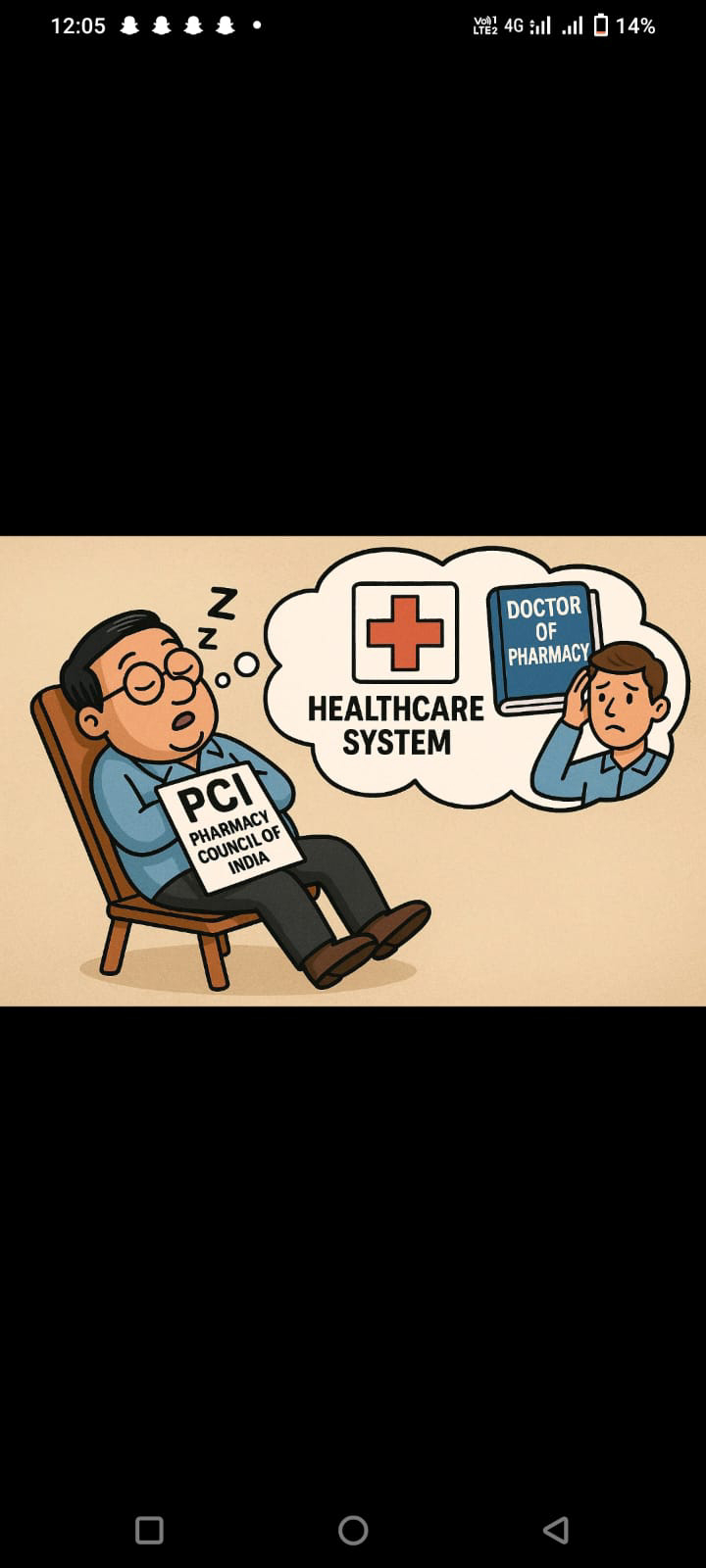
Pharmacist A HealthCare professional? If so why pharmacy course is not?. Has the Pharmacy education been got included in National Health Education Manual?

ok

So many regulatory bodies and governing bodies in pharmacy education: whims of my mind

PCI(Pharmacy Council Of India) and AICTE(All India Council for technical education) are the governing bodies in the pharmacy education , keeping in mind the compounding and dispensing as well as the technical aspects involved in Pharmaceutical Engineering .

Now with the advent of Pharm D course in pharmacy, which is clinically oriented 6 years course in pharmacy and the syllabus is designed such as  first 3 years are same as B.Pharm ( compounding and dispensing oriented) and next 2 years are same as MD Pharmacology (medically and clinically oriented) and 1 year of internship in an attached (minimum- 300 beded) hospital , one may expect MCI (medical council of India) to get into the thick of the things/matters.

As it requires an affiliation with a  hospital( minimum 300 beded), to get approval for an pharmaceutical institute from PCI to conduct the course , one must expect MCI(medical council of India)(Now NMC) also to get involved as a regulatory and governing body.

PCI governs courses like : D.Pharm
                                         B.Pharm
                                        Pharm D and Pharm D(PB)

AICTE governs courses like : B.Pharm( jointly with PCI)
                                              M.Pharm

Now one must expect AICTE,PCI and MCI may jointly govern : Pharm D and Pharm D(PB)

But no, its not a rational thinking on my part. MCI (Now NMC ) will get involve only when the course is a medical one or may be when the professional doctor is dealing with a body part.
So, its fair enough that MCI(NMC) is not involved into these matters.(Really?!!!)


Saturday, 9 August 2025

Is Pharm D and Pharm D(PB) course is approved by UGC?

University Grants Commission (UGC) is a statutory body under Department of Higher EducationMinistry of EducationGovernment of India. It was set up in accordance to the UGC Act 1956 and is charged with coordination, determination and maintenance of standards of higher education in India. It provides recognition to universities in India, and disbursements of funds to such recognized universities and colleges. The UGC headquarters are in New Delhi, and it has six regional centres in PuneBhopalKolkataHyderabadGuwahati and Bengaluru. A proposal to replace it with another new regulatory body called HECI is under consideration by the Government of India. The UGC provides doctoral scholarships to all those who clear JRF in the National Eligibility Test. On an average, each year ₹725 crore (US$86 million) is spent on doctoral and post-doctoral fellowships by the commission.

Monday, 4 August 2025

Pharmacists are Healthcare Professionals or Pharmacare Professionals?

Pharmacists are HealthCare Professionals.

Lets be worth it.

Really!!!,  then why the term ' PharmaCare ' was coined.
Pharmacist A HealthCare professional? If so why pharmacy course is not?. Has the Pharmacy education been got included in National Health Education Manual?

Someone kindled me to define and explain who is Healthcare professional? Where does the Pharmacist fit in?

Healthcare Professional.

Someone kindled me to define and explain who is Healthcare professional? Where does the Pharmacist fit in?

Not an easy question in light of Second question.

Any professional who serves the humans to safeguard his / her health and serves to mitigate the suffering and assists and supports the patient to be as comfortable as possible and treats him directly and fecilitates treatment could be called healthcare professional or Health Worker. All put together could be called a Medical Team

[This is my own extempore definition, I am subject to correction]

Now coming to second question,
Where does the Pharmacist fit in to be called Healthcare professional?

Excluding Pharm D Pharmacists, considering prevailing scenario and practice in India  the Pharmacist looks like a supporter external to the Treatment team  only to dispense what is advised. 

Unless the Pharmacists update themselves  or Course content is updated to familiarise the students on healthcare practices in preventive and curative services Pharmacists of India may not gain the Healthcare Professional tag.

#PCI, #IPA, #APTI,

POV :Bhagwan PS


Pharmacists are HealthCare Professionals.

Lets be worth it.

Really!!!,  then why the term ' PharmaCare ' was coined.
Pharmacist A HealthCare professional? If so why pharmacy course is not?. Has the Pharmacy education been got included in National Health Education Manual?

Digital Prescriptions are the solution

Handwritten prescriptions in India often pose significant risks due to their potential for misinterpretation. The diverse linguistic landscape of India, with multiple languages and scripts, adds to the complexity of deciphering these prescriptions accurately. Common issues include illegible handwriting, which can lead to confusion between drugs with similar names or incorrect dosing instructions. This is particularly problematic given the wide range of medications available and the critical importance of precise dosages.

Moreover, handwritten prescriptions sometimes lack essential information such as patient history, allergies, or specific instructions for drug administration. In a healthcare environment where pharmacists play a key role in the safe dispensing of medications, these omissions can lead to serious health risks.

The situation calls for a more robust system, possibly incorporating digital prescriptions, which can ensure clarity, accuracy, and traceability. Standardizing prescription formats and embracing electronic health records could greatly mitigate the risks associated with handwritten prescriptions, leading to safer and more effective patient care in the Indian context.