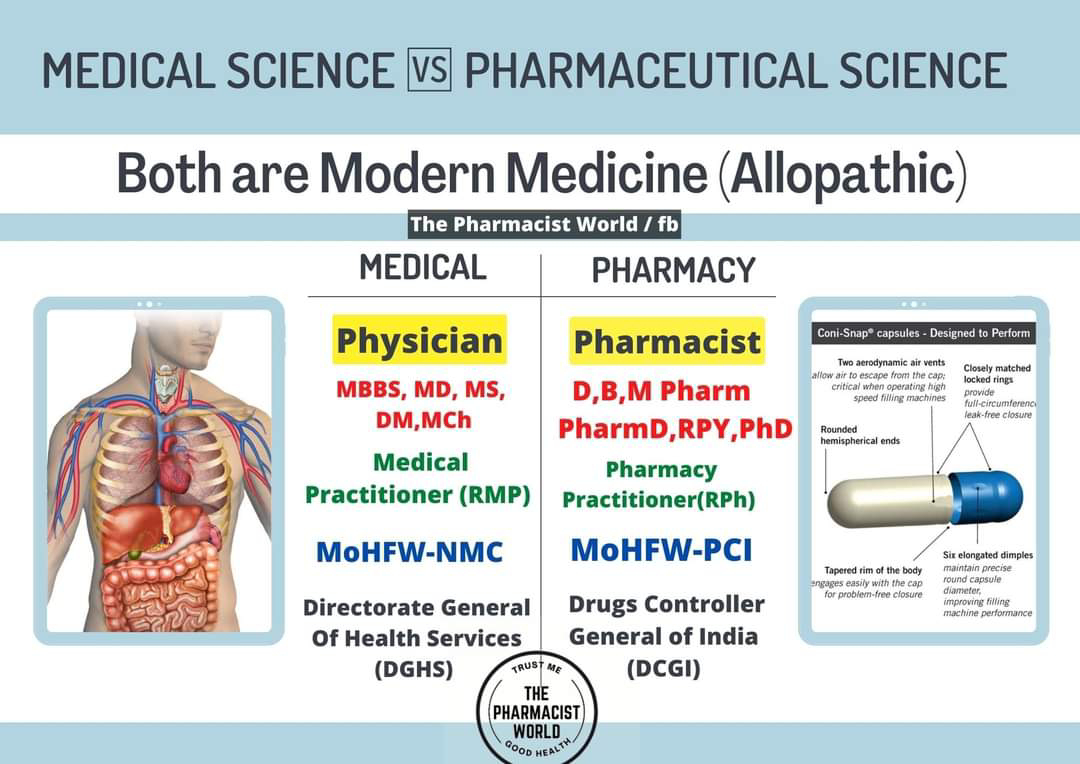
If pharmacists can do as such type of work in pharmacy .separate cell must estblised in pharmacy as a primary care with drug councilling chamber.
Drug can dispence by pharmacists supervision/ presence so there no problems create for pharmacists . But all medicine bill should be signed & inspected by pharmacists.
Now PHARMACISTS can also Practice like Physicians . . . . .within their own Clinical Setups
GOOD PHARMACY NEWS
Advanced Pharmacy Practice Model came to India , introduced by CLINICAL PHARMACY COUNCIL.
- PHARMA CLINIC - A Center of Pharmaceutical Health Care. . . .
Pharma Clinic practice model framed by CLINICAL PHARMACY COUNCIL within certain provisions of PPR-2015 of Pharmacy Act 1948 framed by PHARMACY COUNCIL OF INDIA.
Its a clinical setup outside the hospitals , where qualified registered Pharmacists provides their professional services on individual consultation of patients. within /along with Pharma Clinic Pharmacists also facilitate Drug Dispensing services by getting a Retail Drug license from local drugs regulatory authority.
Practice Pharmacy in your Own Clinical setup on individual patients consultations , collect fees fro professional services. Use sign board with your names and qualifications on the board.
These are all lawful as per Pharmacy Practice Regulations -2015 (PPR-2015) of Pharmacy Act 1948 framed by Pharmacy Council of India.
Now, Pharmacists also can practice as like doctors within their own clinical setups on patients consultations.
As per Sec 2 (I) (II) (III) of Chapter 2 of PPR-2015 A registered pharmacist is eligible to practice pharmacy, pharmacy practice means not only Compound, Labelling and Dispensing of Drugs. Pharmacists also provide the following professional services
- Participation in Drug & Device selection - Administration of Drugs through different routes of administration i.e IM , IV, IVF, SC , PO etc. . . - Drug Regimen VV Reviews - Drug Research - Patient Counselling - Pharmaceutical Care in all specialties like cardiology, Dermatology , Oncology, etc. . . including Primary Care
Pharmaceutical Care is a bunch of 1000's professional services of Pharmacy Practices , for detailed services prescribed by PHARMACY COUNCIL OF INDIA refer Appendix III of PPR-2015 of Pharmacy Act 1948. F As per Sec 2 (g) of PPR-2015 Pharmaceutical Care means - along with patients care a pharmacist can prevent disease or and eliminate disease or and reduction of symptoms ( symptomatic treatment to all uncomplicated diseases ) arresting or slowing of disease process.
As per Sec 2 (h) (iv) of PPR-2015 Clinical Pharmacists may provide care in all health care settings ( Community Pharmacy /Hospitals / Clinics / Nursing Homes / Own Health care or Clinical setups like PHARMA CLINICS .
As per sec 3.3 (b) of Chapter 1 of PPR-2015 A registered pharmacist may display his/her name on sign board along with educational qualifications and PCI registration number.
As per Sec 3.3 (c) of Chapter 2 of PPR -2015 A Registered Pharmacist may use /display suffix any professional degrees , certifications , memberships and honors
CPC registered pharmacists may prefix RCPH and etc. . . specialty certification to their names on sign boards of practice areas or setups.
As per Sec 6.5 of Chapter 2 of PPR-2015 A registered pharmacist may charge / collect fees for their professional services on individual consultations.
As per Sec 11.2 of Chapter 6 of PPR-2015 A registered pharmacist may participate him/herself in public health programs , responsible for prevention and care of epedimic & communicable diseases
As per Sec 13 (s) of PPR-2015 of Pharmacy Act 1948 A registered pharmacist should not claim himself/herself as a specialist. means may claimed on certification of any professional organization in certain specialty .
CPC certified specialist registered pharmacists may prefix these specialty certifications to their names on sign board of any professional practice premises ( including PHARMA CLINIC setup)
Not need to get any approval / permission / NOC from any CMO or DM& HO to establish any setup of Pharmacy Practice ( including PHARMA CLINIC ), But Only for retail sale of drugs you required to get license from local drugs regulatory authority.
If the act ( CLINICAL ESTABLISHMENTS Act 2010 ( Regulations & Registrations ) applicable to pharmacy establishments in any state - the state belonging regd pharmacists may required to register the pharmacy establishment (pharma clinic) under this act with concer
"Public Pharmacist medicine " es AWARENESS campain ko suru karna chahiye pure desh me pharmacist ka naam sabhi ko yaad ho jaye aur naam yaad aate hi pharmacist ka role and importance mind me aaye aur dil me respect.....इसकी जरूरत ज्यादा है की pharmacists इन नियमो खुद ऐसे pharmacy store खोल धरातल पर लागु करे वरना नियम के नाम पर हम खुद को ज्यादा दिन तक नही ढो सकते और लोगो को ये नियम भी फालतू का लगने लगेगा मतलव हम फार्मासिस्ट फालतू के लगने लगेगे
फार्मासिस्ट स्वास्थ्य सेवाओं की महत्वपूर्ण कड़ी है इसलिए वह स्वास्थ्य सेवाओं की सभी सेवाओं का उपयोग कर सकता है
Pharmacists can diagnose disease, treatment ,priscriber medicine ,drug councilling of patient ,stock & dispense medicine ,
सच्चाई यही है
फार्मासिस्ट रोगी की सेवा के लिए कुछ भी कर सकता है परिस्थिति अनुसार यूज करेँ अपने अधिकार फार्मासिस्ट
ELIGIBILITY to Practice PHARMA CLINIC
Pharmacists, who are willing to practice Clinical Pharmacy outside the Hospital setups and within their own Clinical setup PHARMA CLINIC, they should meet the following eligibility criteria:
1. Applicant Pharmacist should be a Licensed/Registered Pharmacist by any state Pharmacy Council of India.
2. Applicant Pharmacist should be a Registered Clinical Pharmacist (RCPh) in Clinical Pharmacy Council (CPC).
3. a. Applicant Pharmacist should be have minimum 3 months experience as a Hospital /or/ Clinical Pharmacist under supervision of MCI Registered Physician of any Hospital.
[OR]
b. Applicant Pharmacist should complete 2 months SAT-CP Training Program in CPC.
राजस्थान के फार्मासिस्ट के लिए CPC ट्रेनिंग जरुरी है क्योंकि उनकी ट्रेनिंग फार्मेसी स्टोर मेँ होती है हॉस्पिटल मेँ नही
HOW TO APPLY
Step 1: If you are not a RCPh in CPC, Register your name as Clinical Pharmacist in CPC with Application FORM-1.
One time Registration Fee: Rs 2600/- only.
Step 2: After Confirmation of Registration in CPC, Apply for Clinical Pharmacy Specialty Certification to BCPS in CPC. For General Practice apply for Consultant Clinical Pharmacist (CCP) certification by submitting your previous or current Experience Certificate [or] SAT-CP Training certificate.
Who are not having Previous Experience Apply for SAT-CP Training Program with Application FORM-2B
For CCP certification apply with Application FORM-2
(NOTE: For any other Specialty Clinical Pharmacy Practice apply for Specialty Certification to BCPS) For Specialty certification apply with Application FORM-3
Step 3: After confirmation of successful Certification, Apply for PHARMA CLINIC approval with Application FORM-4
Step 4: ENJOY YOUR PRACTICE BY SERVING THE MANKIND.
PHARMA CLINICS are Community Health Care setups outside the hospitals and medical homes, where qualified and registered / licensed Pharmacists provide Clinical Pharmacy services to the patients on their individual consultations.
PHARMA CLINICS are Community Health Care setups outside the hospitals and medical homes, where qualified and registered / licensed Pharmacists providesClinical Pharmacy services to the patients on their individual consultations.
A newest pharmacy practice model in India.
To become Clinical Pharmacy Practitioner Member (CPPM) of Clinical Pharmacy Council, register your name by applying in an on-line application. Transform from Tradtional Pharmacy Practice into Advanced Clinical Pharmacy Practice to provide better healthcare to the nation.
Clinical Pharmacy Council (CPC) with the objective to Promote, Support, Strengthen, and Develop the Clinical Pharmacists through Membership Registration and Decolonising throughout India.
Pharmacy profession comprising the Hospital and Clinical pharmacy sectors is under going rapid change in India. Clinical Pharmacy Practice sector need skilled Pharmacy professionals, who can face global challenges and compete with multinationals. The Pharmacist is no longer a mere dispenser of drugs. But has assumed a more Clinical role in Therapeutic Drug, Disease Monitoring and Management and as overall Health Care Provider.
We realized that to Strengthen and Upgrade the Clinical Pharmacy Education and Practice in India, need to competent Clinical Pharmacists Force, which is able to meet the growing demands of the Health Care in India.
Today, a need has been felt on the Imperative for transparency, accountability and accessibility in order to establish Public and Physicians trust in Clinical Pharmacists and their Services in India. This would be feasible only if all Clinical Pharmacists are associated on a single stage.
CPC Membership Registration of Clinical Pharmacists will ensure Transparency, Accountability, and Accessibility in Clinical Pharmacy Services. By disclosing all Results or / and Interventions of Clinical Pharmacy Practice, Public confidence in Clinical Pharmacists in likely to be enhanced.
As a step towards the directions, Clinical Pharmacy Council (CPC) to Recognize Indian Clinical Pharmacists by the Process of Membership Registration and so as to strengthen & upgrade the Clinical Pharmacy Practice in India.
SAT-CCP course is a 6 months duration home based ( DISTANCE ) ContinuousPharmacy Education & Professional Development credential (value added) program.
SAT-CCP course was aimed to educate, train, and advance Traditional PharmacyPractitioners ( Dispensing Pharmacists ) in providing advanced Clinical Pharmacyservices so as to deliver better health care to the nation.
SAT-CCP course improves professional expertise in the field of Clinical Pharmacy and prepares most competent Clinical Pharmacists force to the nation with world class standards.
SAT-CCP course was structured as three different sessions of self Study, Assessment, and Training in the field of Clinical Pharmacy. After successful completion of all sessions of the course the candidates has to appear a qualifying examination.
SAT - CCP (Self Assessment, Training & Certificate program in Clinical Pharmacy) is a Continuous Professional Developement Program in Clinical Pharmacy. It's a 6 months duration home based distance learning program.
SAT-CCP course is a 6 months duration home based ( DISTANCE ) ContinuousPharmacy Education & Professional Development credential (value added) program.
SAT-CCP course was aimed to educate, train, and advance Traditional PharmacyPractitioners ( Dispensing Pharmacists ) in providing advanced Clinical Pharmacyservices so as to deliver better health care to the nation.
SAT-CCP course improves professional expertise in the field of Clinical Pharmacy and prepares most competent Clinical Pharmacists force to the nation with world class standards.
SAT-CCP course was structured as three different sessions of self Study, Assessment, and Training in the field of Clinical Pharmacy. After successful completion of all sessions of the course the candidates has to appear a qualifying examination.
There are two modes qualifying examination:
SAT-CCP course is a 6 months duration home based ( DISTANCE ) ContinuousPharmacy Education & Professional Development credential (value added) program.
SAT-CCP course was aimed to educate, train, and advance Traditional PharmacyPractitioners ( Dispensing Pharmacists ) in providing advanced Clinical Pharmacyservices so as to deliver better health care to the nation.
SAT-CCP course improves professional expertise in the field of Clinical Pharmacy and prepares most competent Clinical Pharmacists force to the nation with world class standards.
SAT-CCP course was structured as three different sessions of self Study, Assessment, and Training in the field of Clinical Pharmacy. After successful completion of all sessions of the course the candidates has to appear a qualifying examination. There are two modes qualifying examination:
- Online (Computer Based Online Examination)
- Offline (Pen & Paper Based Examination)
The mode of selection of the qualifying examination is the choice of the candidate; they have to select any one mode of examination at the time of the enrollment and may change at any time during the course period and just before 7 days of the examination.
COURSE DURATION: 6 Months
FREQUENCY OF COURSE: Admissions are open throughout a year. Applicants are requested to submit application before 25th of the Month, so that program will be starts from 1st of the next Month.
Clinical Pharmacy Council (CPC) is an autonomous Professional Organization that promotes, supports, implements and advances education, practice and research in clinical pharmacy. CPC represents clinical pharmacists and others who are interested in clinical pharmacy and in the development of clinical pharmacy throughout India.
Clinical Pharmacy Council works in non profit motive for the prime objective of - The development, promotion and advancement of Clinical Pharmacy Education and Practice in India.
The CPC actively develops and promotes Clinical Pharmacy Education and Practice as well as develops individual Clinical Pharmacy Practitioners through Professional Curricula, Professional Recognition, Credentialization, Professional tools, frameworks, support and contributes by promoting Advanced Practice of CLINICAL PHARMACY in India.
The CPC is able to access a wide range of Knowledge and Expertise in Clinical Pharmacy to enable high quality patient care in India.
CLINICAL PHARMACY COUNCIL provides certain fellowships (FCPC and FRCPC) annually to the eligible candidates.
CLINICAL PHARMACY COUNCIL provides certain awards annually to the eligible candidates through the nomination process
In India hundreds of pharmacists providing their professional services in certain health care specialties as clinical pharmacy specialists, across the world there is huge demand for Clinical Pharmacy Specialists, Some professional organization providing them professional recognition through certain Specialty Certification Programs.
For MBBS - ALLOPATHY CLINICS,
For BAMS - AYURVEDIC CLINICS,
For BHMS - HOMEO CLINICS,
For BNYS - YOGA CLINICS,
For BUMS - UNANI CLINICS,
For BVSc - VET CLINICS,
For BDS - DENTAL CLINICS,
Even for BPT - PHYSIO CLINICS are there in India.
www.clinicalpharmacy.in/pharma-clini
Pharmacists cannot open clinics to diagnose disease & prescribe medicine; clarifies PCI
|
Swati Rana, Mumbai
Wednesday, October 21, 2015, 08:00 Hrs [IST] |
|
Clearing the doubts on pharmacists can open pharma clinics to treat common disease and prescribe medicine, Pharmacy Council of India (PCI) has recently notified that the pharmacists cannot open clinics to diagnose the disease and prescribe the medicines.
PCI has clarified that there is no provision in the Pharmacy Practice Regulations (PPR), 2015 which allows the pharmacists to practice medicine. Under the said Regulations, the registered pharmacist is required to dispense medicines on the prescription of a registered medical practitioner and can counsel the patient or care giver on medicine to enhance or optimise drug therapy.
The elements of patient counselling includes, name and description of the drugs;the dosage form, dose, route of administration, and duration of drug therapy; intended use of the drug and expected action; special directions and precautions for the drug; common severe side effects or adverse effects or interactions and therapeutic contraindications that may be encountered, including their avoidance, and the action required if they occur; techniques for self monitoring drug therapy; proper storage of the drugs; prescription refill information; action to be taken in the event of a missed dose and to ensure rational use of drugs.
Dr. B Suresh, president of PCI informed that there are few groups of pharmacists who are claiming that they are doctors and there are various messages being circulated on social media, e-mails, WhatsApp etc. that pharmacists are empowered under PPR, 2015 to open pharma clinics to diagnose the disease and prescribe medicines.
We would like to clarify that there are no such provision under PPR, 2015 which allows pharmacists to diagnose and prescribe medicine. PPR, 2015 only allows the pharmacists to practice pharmacy and not medicine, they can counsel the patient or care giver and dispense medicines on the prescription of a registered medical practitioner but cannot prescribe medicines to the patients
He further adds, “Under no circumstances, the registered pharmacist is empowered under the Pharmacy Act, 1948 and PPR, 2015 to practice medicines or open clinics to provide medical care.”
BUT, My query is : Can a registered pharmacist and pharmacotherapist (PHARM D) approved with Clinical Pharmacy Council give PHARMA CARE in his PHARMACY? Services like prior authorization and refill authorization for prescription drugs is permitted?
The short answer is **no, retail or community pharmacists (including PharmD graduates) cannot independently authorize refills or prior authorizations on their own.** However, the complete answer depends heavily on the **setting** they work in and the legal agreements they have with physicians. The role of a PharmD differs significantly across these two processes: ## 1. Refill Authorization A refill authorization means extending a prescription that has run out of refills or expired. * **Standard Retail Setting:** If a patient is out of refills, a retail PharmD **cannot** simply grant a new refill. Legally, they must send a refill request to the original prescriber (MD, DO, NP, PA) and wait for their approval. * **Collaborative Practice Agreements (CPAs):** In many countries (like the US, Canada, and increasingly in clinical settings globally), PharmD graduates working under a formal CPA or "delegated authority" with a physician **can** manage and authorize refills independently for chronic medications (like blood pressure or diabetes drugs) after reviewing the patient's recent lab results and health status. * **Emergency Fills:** Most regions allow pharmacists to grant a small "emergency supply" (usually 3 to 7 days) of maintenance medication if the doctor cannot be reached, to prevent the patient from missing doses. ## 2. Prior Authorization (PA) A prior authorization is an insurance company's requirement that a doctor justify why a specific, usually expensive medication is medically necessary before the insurance will agree to pay for it. * **Initiating the PA:** A retail pharmacist is usually the person who *discovers* the PA is needed (when the insurance claim rejects at the register). The pharmacist cannot complete or approve the PA themselves; they must forward the rejection to the doctor's office, as the insurance company requires clinical notes and diagnoses directly from the prescriber. * **PharmDs Working for Insurance/PBMs:** Many PharmD graduates work directly *for* health insurance companies or Pharmacy Benefit Managers (PBMs). In these roles, their exact job **is** to review, approve, or deny prior authorization requests submitted by physicians based on clinical guidelines. * **PharmDs in Clinical/Hospital Clinics:** PharmDs working directly within a doctor's office or clinic often handle the entire PA paperwork process on behalf of the physician, gathering clinical data to ensure it gets approved quickly.
## Summary of the PharmD Role
| Task | Standard Retail PharmD | Clinical PharmD (Under CPA) | Managed Care PharmD (Insurance) | |---|---|---|---| | **Refill Authorization** | **No** (Must request from doctor) | **Yes** (For specific managed conditions) | **No** (Not applicable to role) | | **Prior Authorization** | **No** (Can only flag it and send to doctor) | **Yes** (Can submit clinical documentation) | **Yes** (They are the ones who approve/deny it) |
A new development may occur:
|